
| Status: | Region: | Type: | Gallery: |
|---|---|---|---|
| Restored | Pennsylvania | Industrial | 41 Photos |
After a weekend of soaking rain, summer foliage is in full bloom in Allentown Pennsylvania. Tall, waist high grasses sprinkle me with ticks as weeds below grab at my ankles like nature's snare. All the while, the slick, muddied soil beneath my boots nearly takes me for a spill into the Little Lehigh Creek; for its banks I am cautiously traversing through an urban forest. At least the creek is calm today, in its modesty, leaving behind a mucky trail littered with broken glass bottles and numerous puddles full with discarded plastic waste. Pushing east, I know I'm making progress as I see in the distance the silhouette of the Ward Street Bridge as it crosses over the floodplain of the creek, connecting the south side of Allentown with the rest of the city.
Walking beneath the shadows of the bridge, I spot of cluster of tents haphazardly propped up against the rear retaining wall of the overpass. Graffiti mars the smooth concrete surface, placed like art above the disorderly tents, no doubt washed up from a prior flash flood. A pair of shoes dangling from their laces remain wrapped around scrubby brush. A blue sleeping bag is coiled around a heavy metal car bumper, which in turn has been jettisoned into the exposed rafters of the bridge. Plastic water bottles and chunks of broken styrofoam form a layer of unnatural soil above the native surface. There is no being discrete. This synthetic carpet, crunching loudly beneath each step I take. No one is home, I presume. I keep walking. Now back out into the sunlight.
The urban forest soon spills into an open clearing, a meadow of sorts, bound to one side by the creek and on the other, a thicket of seemingly impenetrable thorns and weedy overgrowth. Only one way, forward. Long blades of green grass remain limp, washed over like wet hair, indicating the direction the flood waters receded, still too early in the day to be resurrected skyward again by the summer sun. In this moment I am glad for it, a break from the ticks for what otherwise should have been a Lyme jungle at the edge of the woods. At the far end of the field, a large rusty factory looms over the landscape. This is my target. Continuing forward. The forest abruptly stops, replaced by an asphalt driveway riddled with cracks from which ghetto palms make home. A heap of dead, washed up trees have been suspiciously cast into a pile at the edge of the cracked driveway. A lazy attempt at a deterrent to keep such undesirables as myself out from the playground just ahead.
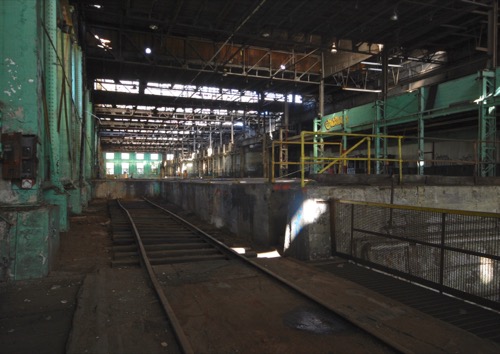
I can see it now. Barely halfway down the rutted, overgrown road, an entrance is already welcoming my arrival. It appears the flood waters have forcefully blasted open an industrial-grade roll-up door. Dashing inside, I crouch beneath the busted door, now a potential guillotine; my eyes take a moment to adjust to the shadows as my ears take the lead. I hear a trickle of water flowing out of the warehouse. I pause. High atop the roof, a dead ventilation fan squeals in agony, a calm breeze forcing its rusty fins to move against their will. Inside, the air is still cool, holding prisoner the dampness from the previous evening, before the rising sun again sets it free. Patches of sticky brown mud slicken the cement floor, likely washed through the ruins by the weekend's heavy rains. Within the silt, footprints appear, then disappear. They are not mine. I am not alone.


