
| [Home] | [Locations] | [Links] | [About] | [Extras] | [Contact] | [Donate] |

Psychogeography - Learning to Get Lost
Posted: Monday February 9, 2026

I like to consider it my best attempt at wasting time wisely, which roughly hints to the years that I've dedicated toward urban exploring and photographing abandoned buildings. However, it only ever more recently occurred to me that I've effectively completely ignored the cities and towns that these ruins exist within. Sure, I've traveled to many new places, but always with the narrow goal of seeking out to explore a specific ruin or embark on loosely planned adventures. Yet, once I got my adrenaline and photography fix from said location, I'd head out, paying little notice to the urban environment around me. In retrospect though, the places that have birthed such adventures, often are just as interesting as the exploration of the actual thing itself.
A few years ago, I discovered the "New Topographics" which is in short, a photography movement (and later exhibition) that gained traction starting in the 1970s for showcasing and photographing human-altered landscapes. These images were often always black-and-white exterior focused images and would center on documenting the seemingly benign urban, suburban, and industrial landscapes that were rapidly evolving and transforming society at that point in history.
There is a lot of cross-over between Urban Exploration and the New Topographics style of photo documentation. Where it differs though, is the New Topographic's style strived to captured more of the emotion of a scene rather than a sense of adrenaline or historical preservation motive that could be derived from actual urban exploration photography. I became a bit transfixed with looking at such scenes and went down bit of a journey Googling as many of the original New Topographic images as I could find online. The photos I saw ignited a fresh sense of curiosity within me that sort of brought me back to the initial excitement of exploring ruins as a young kid growing up in the suburbs of New Jersey.
Discovering the New Topographics movement implored me to slow down, to appreciate, study, and photograph the built environment as much as I would the particular location that encompassed me into the environment. Anyway, as one goes down a new rabbit-hole of an interest, new discoveries are made and it was soon after I discovered an unfamiliar term called "Psychogeography" that was often paired with New Topographics imagery. Ironically, according to the Merriam-Webster Dictionary, "Psychogeography" may not even be a real word, as it is not associated with any official definition. However, Psychogeography does have a Wikipedia Page which defines the "word" as the "exploration of urban environments that emphasizes interpersonal connections to places and arbitrary routes".
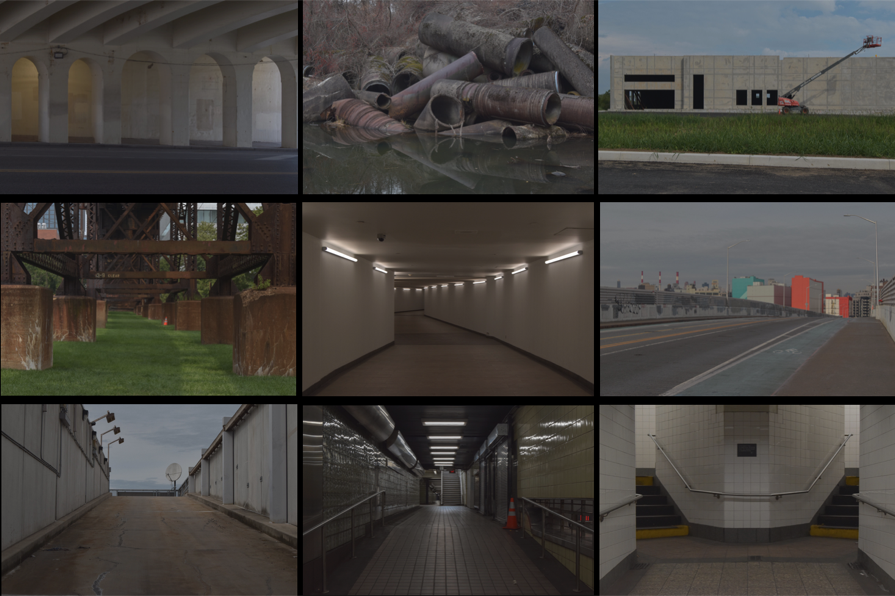
This definition and overall idea influenced me greatly and so I began to embrace attempting to capture, photographically, the connection I felt while wandering around urban environments as a whole, as opposed to just focusing on a specific ruin or building. This brings me to the current theme of this blog post. Over the past five years or so, I've been embarking on psychogeography photowalks through urban environments. The goal is simple. I'll pick a city that interests me and aimlessly walk ten to fifteen miles around the streets with my camera, trying to preserve the connection I feel and how it may be impacted by the man-made environment that I've immersed myself within.
I have no exact agenda in mind, except to drift around random streets, almost trying to be invisible, with the hope of getting lost. With the photos I make, my intent is to preserve a moment or a feeling sans any deliberate human interaction, as opposed to photography associated with pure photo documentation, urban exploration, or street photography that includes human subjects. The overall plan is to post a series of psychogeography based photowalks as blog posts. Each new entry will highlight, via pictures and an accompanying short narrative text, a different city that I have explored and traversed via foot. Think of it as a hybrid between the familiar urban exploration photos married with a dose of street documentation that leans more heavily toward the influence of how the geographical [urban] environment I'm in, manipulates my own mind and behavior, in that moment the camera shutter clicks.
 |
